
Editors’ Note: This article is part of the series Digital Anthropologies in East Asia.
As I walked through the corridor at Onnuri Church in Seoul, South Korea, I nearly passed by a bespectacled man holding a sign that read, “IT Missions School, 2nd floor” (IT sŏn-kyo-hak-kyo). Seeing the sign, I paused and asked him what kind of people would be attending the event, whether it was a conference for missionaries or whether it was open to anyone. “Can you use a smart phone?” he asked warmly. “Anyone who can use a smart phone is welcome.”
Over the next six weeks, several professional missionaries and around twenty students (myself included) met to train in IT missions at the school. We discussed how Korean Christians might use information technologies to evangelize and to “fight ISIS,” whom in 2015 the participants saw as winning the “spiritual war” (chŏng-sin-ŭi chŏn-chaeng) being waged through social media. Sessions included lectures by religious leaders and small group projects to develop and/or use mission technologies, intermingled with worship and prayer.
The lectures framed the IT Missions School—and South Korean Christianity—within a particular global history of technological progression. IT missions were deemed the appropriate response to the “new paradigm” (sae-lo-un p’ae-lŏ-ta-im) that accompanied the “IT age” (IT si-tae). The lectures detailed the “IT infrastructures God had built” (ha-na-nim-ŭn IT in-p’ŭ-la-lŭl ku-ch’uk-ha-syŏss-sŭp-ni-ta) to equip Christian missions throughout history, culminating in discussions of the media technologies the leaders were currently developing. Drawing upon Max Weber’s famous thesis of the elective affinity between Protestantism and rational capitalist development, these lectures argued that South Korean Christians had a unique calling to become IT missionaries. Weber, they said, demonstrated the close relationship between Protestantism and industrialization as they developed in Europe and North America. The historical coincidence of technological innovation at Korean conglomerates like Samsung and LG and the late growth of Protestantism in Korea (now the world’s foremost missionary-sending nation) signaled that “It’s Korea’s time,” as Loren Cunningham of Youth with a Mission (YWAM) announces in one IT Mission School video. In this context, the lectures communicated that the fate of both the nation’s tech industry and global Christendom depended upon South Korean Christians embracing the marriage of Christianity and technological invention.
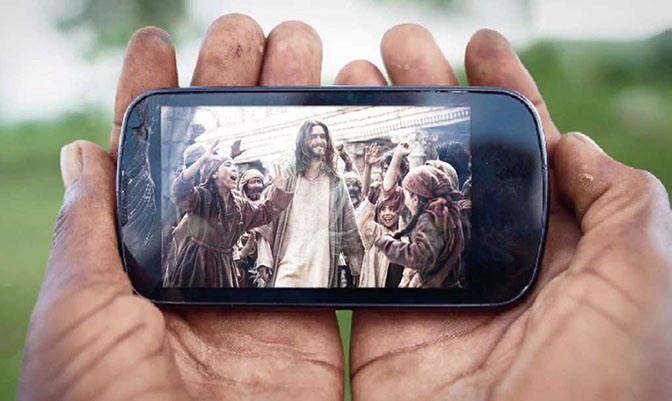
Two leathery hands cradle a smart phone whose screen, like the hands themselves, is cracked. On the phone appears the image of a smiling Jesus Christ amidst a throng of disciples. This picture appears in a video advertisement for “Smart Bible,” an IT missions project that uploads Christian media onto donated smart phones such that short-term missionaries can leave these devices with people in their mission field. FMnC.
I participated in a small group project on social media evangelism, the title of which roughly translates to “Missions at the End of One’s Hand” (son kkŭt’ sŏn-kyo). We were asked to create evangelism projects with the guidance of an experienced, professional missionary. Participants began cautiously posing ideas to turn their daily activities on social media into something of a mission field. One woman offered that she could use her Instagram and Pinterest accounts to spread positive, Christian messages. People spend time on these apps, she noted, because they may feel bored or perhaps are attracted to pretty images, designs, and inspirational quotes. “A couple of users I follow post touching [kam-tong-chŏk-in] pictures. Paintings of scriptures, too. Often, these posts really touch my heart [ma-ŭm kam-tong-si-k’i-ta]. So I think for my project, I can pray over Pinterest and ask God to tell me with whom I should share certain pictures.”
The unique place of Korean technology missionaries in the world was reinforced repeatedly, for example, through the project leader’s slogan for such work: “CLICK & TOUCH: Through the IT God put in our hands, click and touch the whole world” (CLICK & TOUCH: han-na-nim son-e put’ tŭl-lin IT-on se-sang-ŭl k’ŭl-lik-ha-ko t’ŏ-ch’i-ha-ta). Repeatedly, our leader prayed that God would inspire projects to transform cyberspace into the Kingdom of God, particularly in this period when, he argued, ISIS was successfully bending cyberspace in their own spiritual direction. At once a plea to God and a motivational speech to his team, his prayers advanced a vision of cyberspace allowing IT missionaries to do the kind of missionary work befitting God’s omnipresence—wherever, whenever, with whomever (ŏn-che-na, ŏ-ti-na, nu-ku-na).
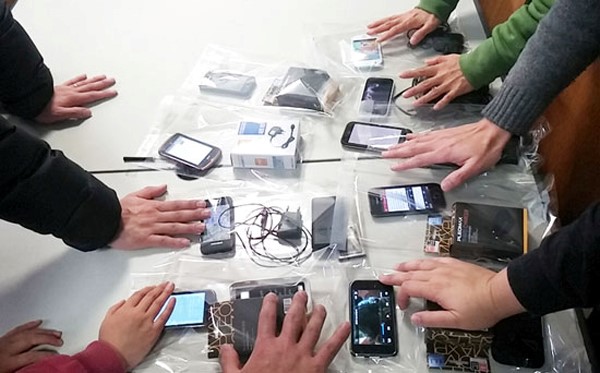
IT missionaries place their hands on donated smart phones, praying that God would touch people through the use of these devices. FMnC.
Heather Mellquist Lehto is a PhD candidate in sociocultural anthropology at UC Berkeley, with a master’s of theological studies from Harvard Divinity School. Her dissertation explores technology in religious practice through ethnographic research at transnational churches in South Korea and the United States.
Cite as: Mellquist Lehto, Heather. 2017. “Click and Touch.” Anthropology News website, November 15, 2017.